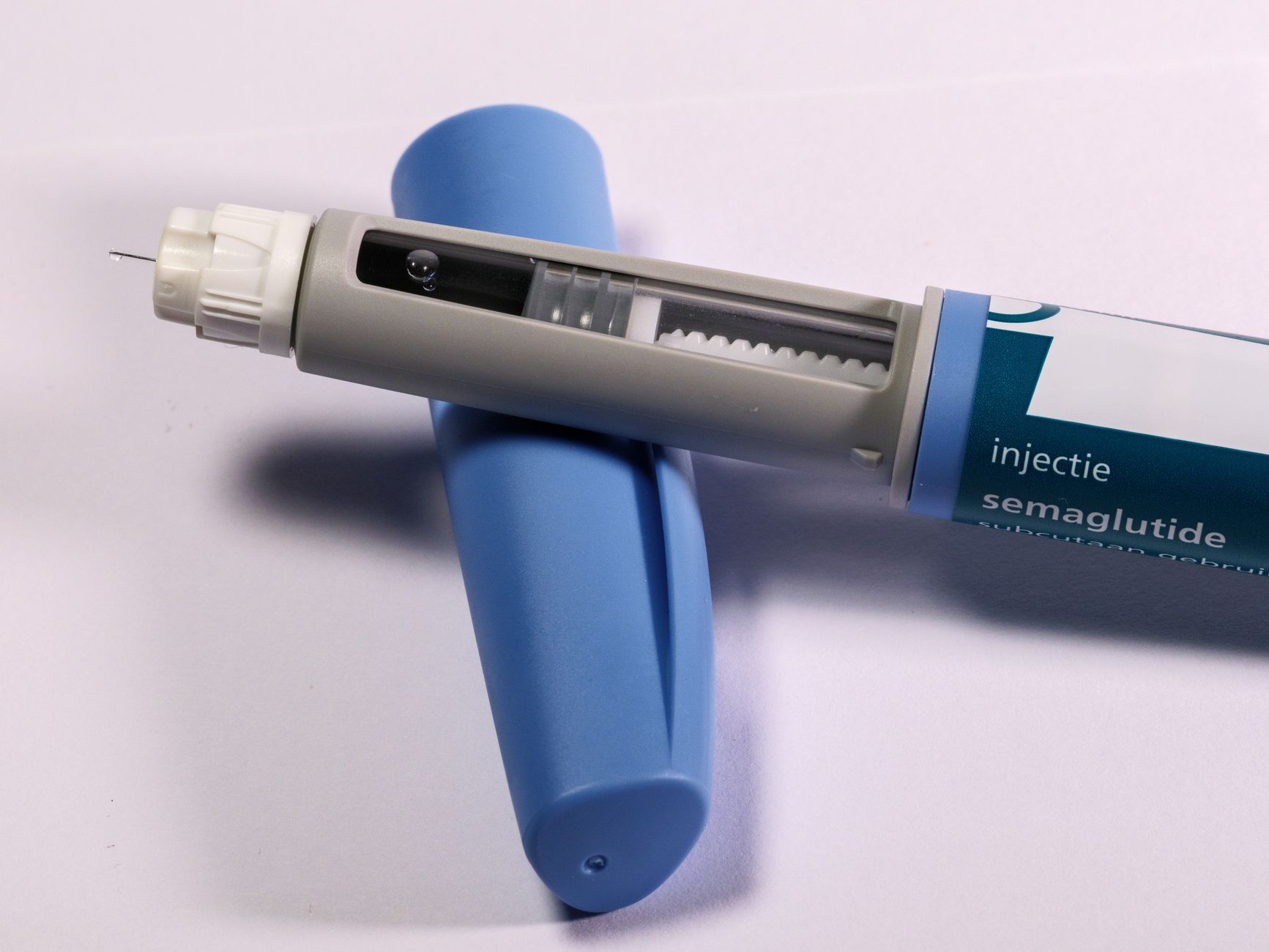
A semaglutide reconstitution calculator is a small conversion tool. It takes numbers a researcher already has, the milligrams of compound printed on the vial and the millilitres of sterile diluent added, and returns other numbers: the concentration in the vial and the units that correspond to a given target amount on a syringe. It does not decide anything. It is arithmetic wrapped in a friendly interface, the same way a currency converter turns one figure into another without recommending how much to spend. This article explains the chemistry and the measurement behind that arithmetic so the output stops looking like a black box. Everything below is education for handling research peptides, not medical advice, and no dose is suggested at any point.
Semaglutide, like most research peptides, ships lyophilized, which means freeze-dried into a solid cake or powder. In that state it cannot be measured by volume, only by the labelled mass. To turn a labelled mass into something a syringe can read, the powder must be dissolved in a sterile liquid. Once it is dissolved, the whole question becomes one of concentration, and concentration is where a calculator earns its place. You can run the same figures in the peptide reconstitution calculator as you read along.
What a semaglutide reconstitution calculator actually computes
Three inputs drive the entire calculation. The first is the mass in the vial, the number of milligrams of compound the certificate of analysis says are present. The second is the diluent volume, the millilitres of sterile water you choose to add. The third is a target amount, an abstract quantity you want to locate on the syringe barrel. From these three the tool derives two outputs: the concentration and the volume, or unit mark, that holds your target amount.
The core relationship is short enough to memorise:
- Concentration (mg/mL) = mg in the vial / mL of diluent added.
- Units to draw on a U-100 syringe = (target amount in mg / concentration in mg/mL) x 100.
The factor of 100 in the second line comes from the syringe itself. A standard U-100 insulin syringe is graduated so that 100 units span exactly 1 mL, which makes 1 unit equal to 0.01 mL. So 50 units is 0.5 mL and 10 units is 0.1 mL, regardless of what is dissolved in the liquid. The syringe measures volume; the calculator translates your mass target into that volume for you. Because the unit mark is a volume, the same target amount lands on a different mark whenever the concentration changes, which is exactly why the mixing step matters.
The two numbers that fix concentration
Concentration is not a property of the peptide. It is a property of how you prepared the vial. Two people can hold identical vials of the same labelled mass and end up with completely different concentrations simply because one added more water than the other. Our companion article on why the same vial gives different concentrations walks through this in more depth, but the short version is that mass in the vial is fixed by the manufacturer and diluent volume is chosen by you, so you control one of the two levers.
The diluent for a multi-day vial is usually bacteriostatic water, which is sterile water containing about 0.9% benzyl alcohol. The benzyl alcohol is a preservative that lets a vial be accessed several times over a period of days without the water becoming a growth medium. The choice of diluent does not change the mass of compound present, so it does not change the concentration formula, but it is part of the general handling picture rather than the arithmetic.
Because concentration is mass divided by volume, the two inputs pull in opposite directions. Add more water and the concentration falls, spreading the same milligrams across more millilitres. Add less water and the concentration rises. Neither is more correct in a measurement sense; they simply place your target amount on different unit marks. If a mark sits at an awkward fraction, adjusting the diluent volume is the lever that moves it.
A worked example in clean round numbers
The figures below are a math demonstration only. They are round numbers chosen to make the arithmetic transparent, not a suggestion about any quantity to use. Suppose a vial is labelled as containing 5 mg of compound. The table shows how concentration responds to three different diluent volumes.
| mg in vial | mL of diluent | Concentration (mg/mL) | mL that holds 1 mg | Units on U-100 for 1 mg |
|---|---|---|---|---|
| 5 mg | 1 mL | 5 mg/mL | 0.20 mL | 20 units |
| 5 mg | 2 mL | 2.5 mg/mL | 0.40 mL | 40 units |
| 5 mg | 5 mL | 1 mg/mL | 1.00 mL | 100 units |
Read the table across and the pattern is clear. The mass in the vial never moved; only the water changed. Yet the number of units that represents the same 1 mg of compound went from 20 to 100. That is the whole reason a calculator is useful: it removes the mental division and multiplication so the unit mark is exact rather than estimated. To go the other way, from a mark you can already see on the barrel back to a mass, the units-to-mg calculator reverses the same relationship.
It is worth pausing on the metric conversions that sit underneath all of this, because a mislabelled unit is a common source of error. The relationships are fixed and never vary by substance: 1 mg = 1,000 mcg = 1,000,000 ng, and 1 mcg = 1,000 ng. A target written in micrograms has to be converted to milligrams before it enters the concentration formula, or the answer will be off by a factor of a thousand. Our note on microgram and milligram mistakes covers where this trips people up.
Why semaglutide is usually measured, not converted to IU
People sometimes ask for a milligram-to-IU figure for semaglutide, expecting a single conversion factor. There is not one. International units (IU) measure biological activity, not mass, and the relationship between IU and milligrams is specific to each substance where it is defined at all. For a compound measured and labelled in milligrams, the practical unit on the syringe is the volume mark, which is what a reconstitution calculator produces. This is different from the job done by a unit helper such as the semaglutide units calculator, which focuses on translating an already-prepared concentration into syringe marks. The two tools are complementary: reconstitution fixes the concentration, and the units helper reads that concentration onto the barrel.
If you want a general reference rather than a live calculation, the insulin syringe units chart lays out the units-to-mL relationship for U-30, U-50 and U-100 barrels. Those three barrel sizes, 0.3 mL up to 30 units, 0.5 mL up to 50 units and 1 mL up to 100 units, all share the same 1 unit = 0.01 mL scale; they differ only in how far the barrel runs and how finely it is graduated.
Handling and storage after reconstitution
Once a lyophilized compound is in solution its stability profile changes, and this is general handling information, not medical advice. Reconstituted research peptides are generally kept refrigerated and protected from light, because both heat and light can accelerate degradation. How long a given solution stays stable depends on the specific compound, its formulation and the diluent, so the certificate of analysis and any published stability data for the exact material should always take priority over a general rule. Our overview of storage and stability after reconstitution expands on the handling side.
Stability over time is itself an exponential process for many compounds, described by a half-life, the time for a quantity to fall to half its value. After two half-lives roughly 25% remains, and after three about 12.5%. That is a separate topic from reconstitution arithmetic, but it explains why a vial is not treated as indefinitely stable once mixed. If you are curious how a decay curve behaves, the half-life decay calculator models it from any stated half-life.
Two practical measurement points are worth keeping in mind. First, the labelled mass is an assumption: the calculator trusts the number on the certificate of analysis, so a mislabelled or misread vial propagates straight into every downstream figure. Second, small diluent errors matter more at low volumes, because a 0.1 mL slip is a larger fraction of 1 mL than of 5 mL. Measuring the water carefully is part of getting a clean concentration. For a full walkthrough of the physical steps, the pillar guide on how to reconstitute peptides is the place to start.
Putting it together
A semaglutide reconstitution calculator is best understood as three inputs and two outputs, governed by one division and one multiplication. Mass in the vial and millilitres of water set the concentration; concentration and a target amount set the unit mark on a U-100 syringe. Everything else, the choice of bacteriostatic water, the refrigeration, the light protection, is handling context around that arithmetic. Keep the units consistent, trust the certificate of analysis for the labelled mass, and the numbers stay honest.
This article is for education and research reference only. It is not medical advice, it does not recommend or imply any dose, and it describes measurement, chemistry and general handling rather than use in people or animals. Always follow the certificate of analysis and stability data for the specific material you are working with.